
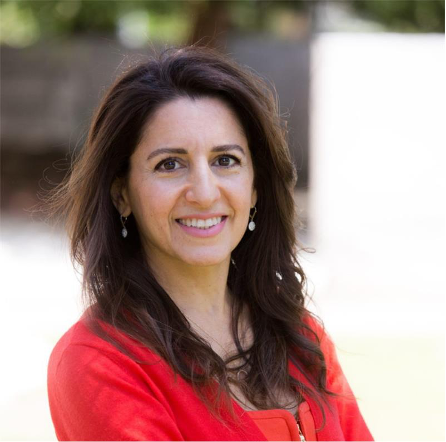
Nazanin Zargarpour
M.P.P., Ph.D
The Learning Collaborative Institute
Nazanin Zargarpour
Dr. Nazanin (Nazy) Zargarpour, M.P.P., Ph.D. (she/her), Nazanin Zargarpour, M.P.P., Ph.D., has dedicated her 30-year career to combining the science of research with the art of collaboration, to drive systems change across Education, Public Health, and Government, creating communities where people belong and thrive.
She is founding President of two social justice focused organizations. Capacity To Impact, an applied research and evaluation firm, works exclusively with social impact organizations to create transformational change in communities. The Learning Collaborative Institute is a non-profit organization that strengthens cross-sector partnerships to advance outcomes for underrepresented communities. The Institute was recognized as “the kind of change we need in California” and received the California Educational Research Association’s Exemplary Research-Practice Partnership Award.
Zargarpour’s work is anchored in earlier professional experiences as administrator of a 100% minority school district and as professor of Educational Research and Reform at Claremont Graduate University. Her deep faith in humanity fuels her vision, and her mission is forged in the formative experience of religious persecution that shaped her early life as a child refugee. Drawing on her own experiences with othering, Zargarpour is committed, both personally and professionally, to designing for belonging across communities and social systems.
SESSION OVERVIEW
My Education in Belonging: The Work Between Othering and Thriving
When we belong, we thrive. Children who feel a sense of belonging in their families are more resilient and go through life with better coping mechanisms, so they enjoy better long-term health. Students who feel they belong in their school, college, or university perform better academically, setting them up for greater life earnings and quality of life. People who feel they belong in their workplace are more productive and stay longer at their jobs. People with more positive social connections live longer, healthier lives. Sadly, the opposite is also true. When we don’t feel we belong in the varied spaces of life, we suffer the opposite results. It may be said that the opposite of belonging is othering. Belonging is made by design, while othering is made by bias, much of which is often invisible, sometimes even to ourselves.
Othering runs across a range. At one end of this range, we see explicit discrimination and persecution based on race, religion, gender, ideology, and identity. At the other end of this range, there are the implicit biases and stereotypes we hold without knowing. Research on stereotypes shows how these implicit biases can shape how we see ourselves, our relationships, and the world around us and the very consequential impacts these perceptions can have on the trajectory and quality of our lives.
Explicit and implicit othering can have significant detrimental consequences for individuals and society. Belonging asks something different of us. It asks us to recognize bias, name it, and transmute it, in ourselves and, through our example, also in others. We design belonging when we create spaces and use language and behavior that invite people to show up as their full selves.
In this keynote, Dr. Nazanin Zargarpour explores both belonging and othering, by drawing from research, sharing her lived experience as a child refugee, and highlighting strategies and examples from her 30+ years of professional experience as a scholar-practitioner working to build school environments where students from all backgrounds belong and thrive. Throughout, Zargarpour leans heavily into the transformative question: “How can we design for belonging, in ourselves, in our many lived spaces, and in the systems and structures of our society?”